
Trading signals and automationDo not trade manually.
Turn any strategy into an automated trading system in 5 minutes.
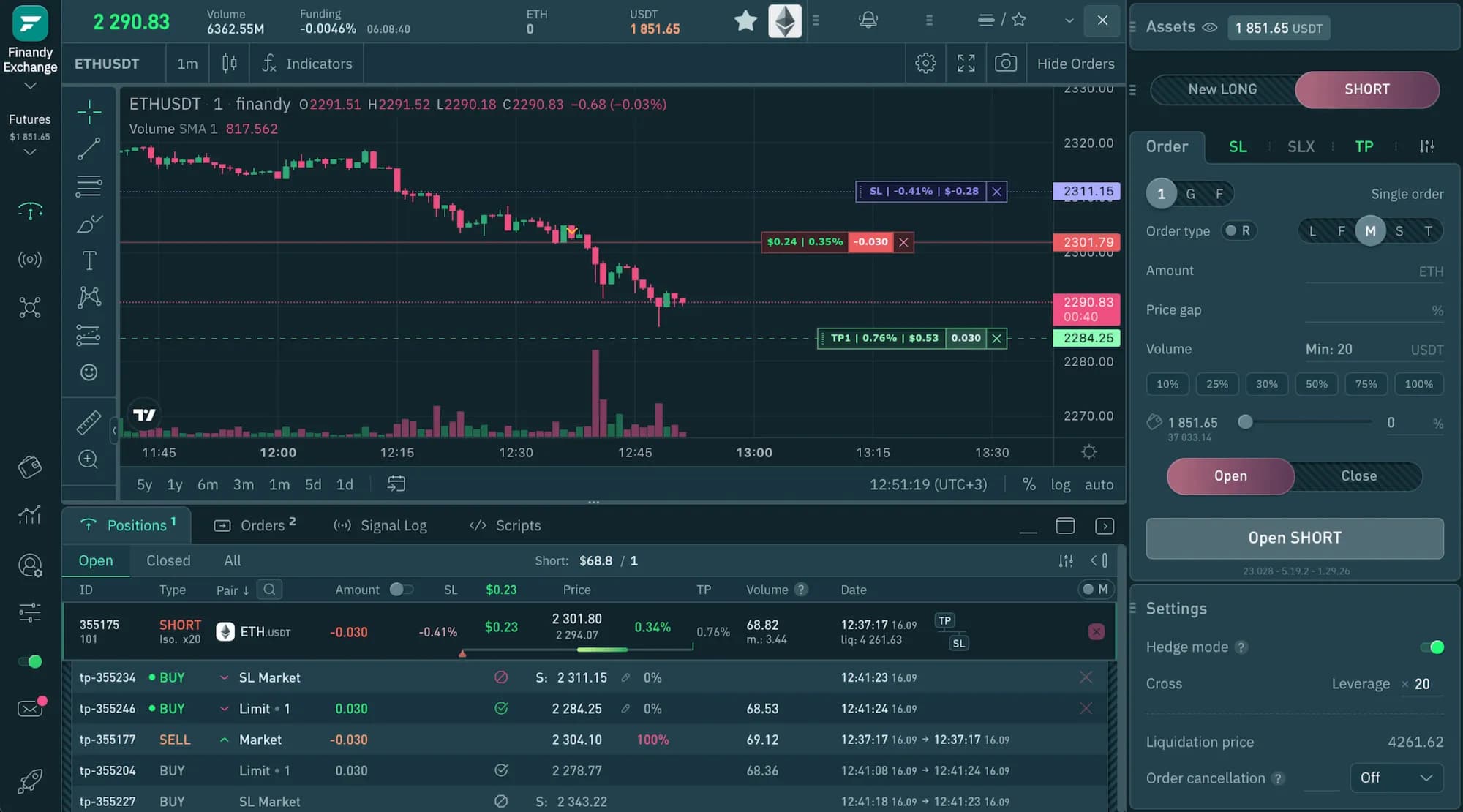
100,000+
traders trust Finandy
since 2017
in the crypto trading market
$75+ million
daily turnover of our users
What are trading signals
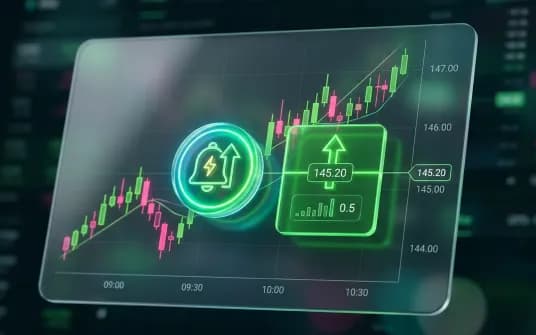
A trading signal is a digital message (command) that contains a condition for making a trade.
Without automation, you receive a push or a Telegram message and manually go to open the trade.
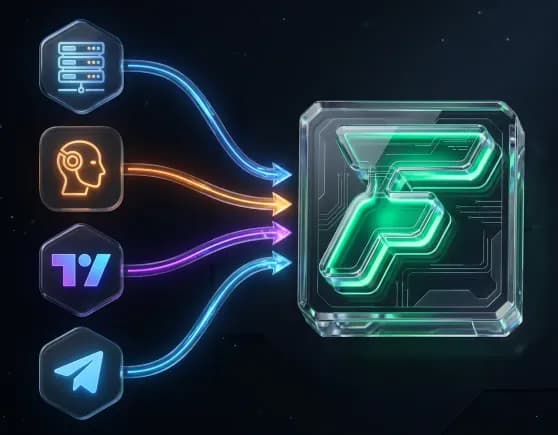
With Finandy trading signals, you link the signal source with your exchange account via the terminal, and the trade is opened automatically in milliseconds.
It's like a constructor:
How trading signals work in Finandy
Finandy is an interface that takes trading signals and turns them into real trades on the exchange.
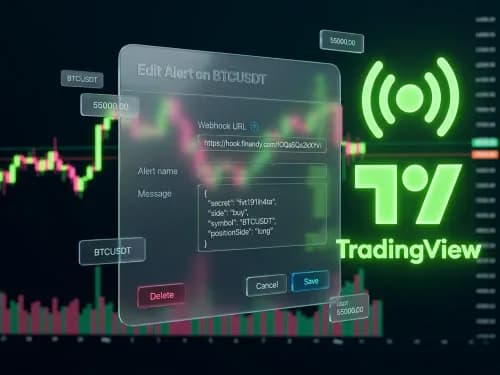
1. Creating a signal
You create a signal in TradingView (an indicator or strategy) or connect your own source: a server, script, bot, API.
At this stage, you don't think about trades.
You form the logic of the strategy — under what conditions the market becomes interesting
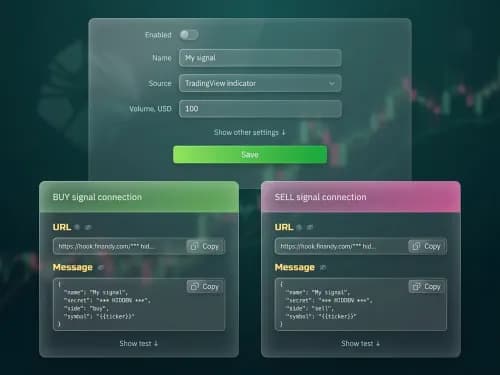
2. Setup in Finandy
Specify what to do when a signal is received: open a position, close it, change an order, set a stop loss or take profit.
Here you also set key parameters: exchange, trading pair, trade size, entry logic, risk limits, order type.
In fact, this is the stage where the strategy becomes a system.
3. Receiving a signal
The system receives the signal in real time.
At this stage, the main problem of manual trading is eliminated: delays, doubts, emotions, and the human factor.
The system reacts exactly at the moment when the conditions are met.
4. Opening a position
Finandy automatically creates a trade on the exchange with the specified parameters.
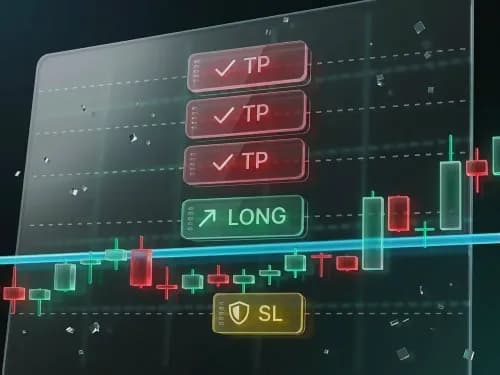
A real trade is opened with the parameters set in the settings: volume, direction, order type, protection and profit-taking levels.
If the strategy involves complex logic, such as partial entries, a dynamic stop, or a cascade of orders, Finandy implements this without your participation.
5. New signal — new action
Each subsequent signal continues to manage the position.
• Exit signal — Finandy closes the trade. • Partial fix signal — closes part of the volume. • Reversal signal — closes the current position and opens a new one. • Trailing signal — changes the stop-loss or take-profit.
Thus, the strategy begins to 'live': it reacts to the market, rebuilds, and records the result.
You don't press buttons. You manage the logic.
Result
A trading strategy ceases to be a picture on a chart.
It becomes an autonomous trading system that receives signals, opens trades, maintains positions and closes them according to the rules.
Trading signals from TradingView - the most popular scenario
TradingView is the largest ecosystem of indicators, strategies and algorithms. Thousands of ready-made solutions, millions of traders, constant updating of ideas.
Finandy integrates directly with TradingView and allows you to:
You find or create a strategy in TradingView - Finandy turns it into a trading system
Start with a simple strategyWho is the trading signal service for?
For those looking for a simple solution
You don't want to analyze the market every day.
You want to get ready-made signals and have the system trade for you.
For those tired of manual trading
You have signals. You have ideas.
There is a lack of automation, discipline, and speed.
For algorithmic traders
You have your own systems, servers, models.
Finandy becomes the bridge between the signal and the exchange.
For those who want a new perspective on trading
Not 'guessing on charts', but manageable trading processes
Why automated trading signals are the future
Markets have sped up. Human reaction has not.
Switching to signals gives 5 key advantages:
- •instant execution without delays
- •lack of emotions
- •logic stability
- •scalability of strategies
- •the ability to work with several markets and ideas at once
This is no longer a 'trader's assistant'.
This is the infrastructure for algorithmic trading.

Signal setup is accessible even to beginners
The Finandy interface is designed so that not only a developer can work with trading signals.
Lite mode
for those who want to quickly connect signals from TradingView
Pro mode
for those who build complex trading systems
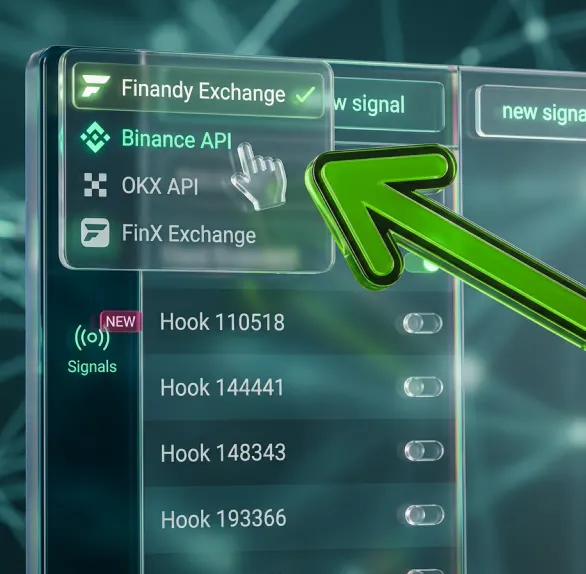
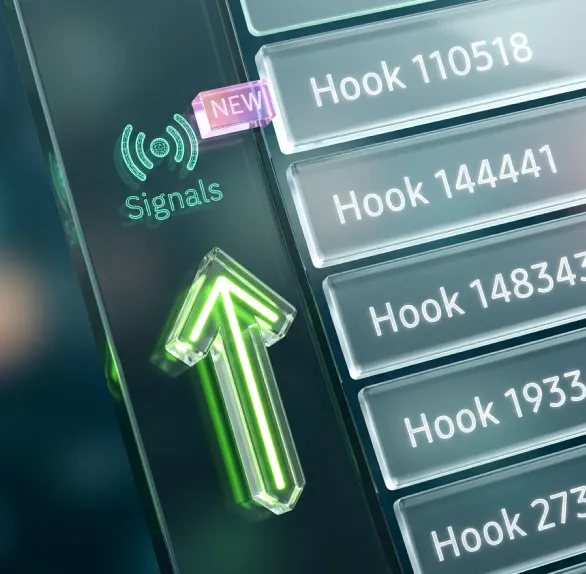
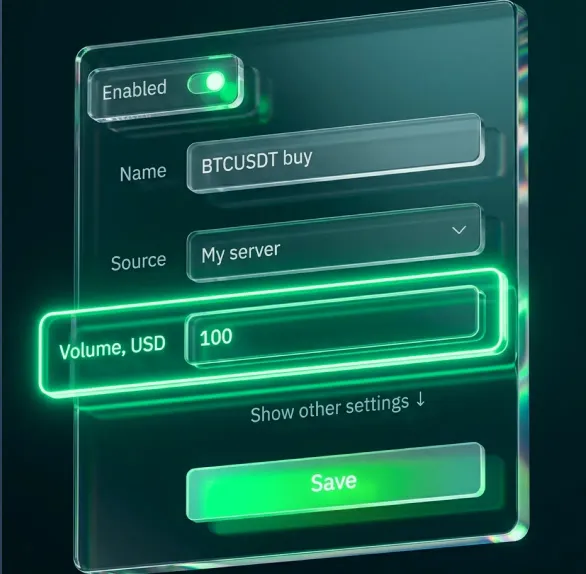
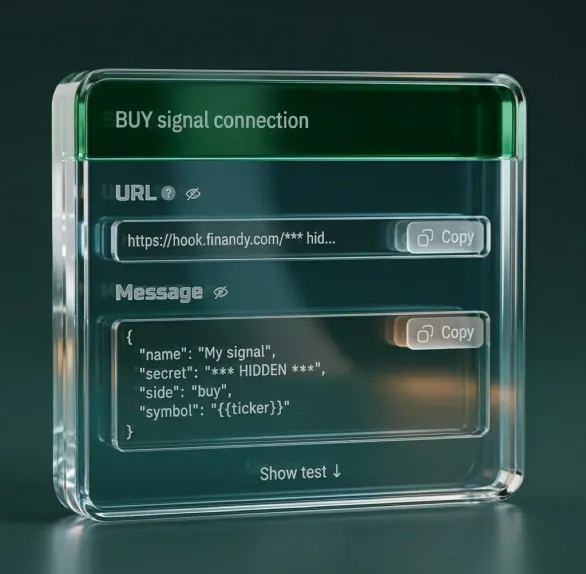
Select exchange and market
Open the Signals menu
Set trade volume
Generate a message for TradingView
Paste the text into TV settings
Signals from any source
You can receive signals:
- from your own servers
- from algorithms
- from trading bots
- from analytical systems
- from any services that can send signals
Support and guidance
The team helps:
- connect TradingView
- set up signals
- check correctness of work
- adapt the strategy for automated trading

Frequently asked questions about trading signals and automation
Here we have collected answers to the most popular questions about trading signals. If you haven't found yours, write to our support.
Is it paid?
Depends on the selected plan. More details in the Pricing.
Can I use signals from Telegram?
Not directly, but you can use an intermediary (e.g. webhook) that converts the signal into Finandy format.
What if the internet disconnects?
Everything runs on cloud servers. Your personal internet does not affect signal execution.
Is it difficult to set up?
No. In Lite mode, it takes a couple of minutes.
Are there any delays?
Finandy is optimized for minimal latency. Signals are processed in milliseconds.
Cryptocurrency trading signals and automated trading in Finandy
Trading signals have long ceased to be simply “buy or sell” recommendations. In the cryptocurrency market today, a signal is a decision point, the speed and accuracy of which directly determines the transaction. This is why more and more traders are moving from manual work with channels and messages to automated solutions. Finandy is a service that allows you to receive cryptocurrency trading signals, configure their processing and automatically execute transactions on the exchange. The system works with signals from TradingView, external sources and proprietary algorithms, turning trading ideas into real trading. ## How trading signals work in Finandy
In the classic format, a trader receives a signal in a telegram channel, reads the analyst’s recommendation, opens a chart, manually places an order and controls the transaction. This process is always associated with delays, errors and emotions. In Finandy, the logic changes. The signal enters the system and becomes a command: open a position, close a deal, change order parameters or fix the result. The platform receives signals in real time, processes them according to specified rules and automatically sends trading transactions to the exchange. This allows you to:
- remove manual entry of orders
- reduce the time between a signal and a transaction;
- centralize work with several signal sources;
- withstand systematic trading instead of chaotic entries. Essentially, Finandy becomes the link between signals and the market. ## Where can I receive signals from?
Most users start with TradingView. This is the largest environment where trading ideas, indicators, algorithms and strategies are created. Signals from TradingView can be generated based on technical analysis, support and resistance levels, volume, market momentum, fundamental background, or a combination of factors. ## In addition to TradingView, you can connect to Finandy:
- own bot or server;
- external signal provider;
- analytical system;
- closed channel with cryptocurrency signals;
- proprietary algorithms and trading strategies. This is convenient both for traders who use paid cryptocurrency signals, and for those who develop their own models and want to automate trading. ## Why automation is better than conventional channels with signals
The Telegram channel with signals remains a popular format. But it is not suitable for systemic trading. Even a high-quality signal loses some of its potential if the trader did not have time to enter the market, made a mistake in the volume, or missed the moment of closing the transaction. The automatic format solves these problems. ## Signals in Finandy:
- executed without delay;
- do not depend on the presence of a trader at the terminal;
- allow you to set risk parameters in advance;
- simplify control of statistics and transaction history;
- remove emotional decisions. This is especially important in the cryptocurrency market, where volatility and sharp movements make manual trading vulnerable. ## What problems are solved by trading signals in Finandy
The trading signal system is used not only for “entries”. Finandy uses them as a full-fledged transaction management tool. In practice, signals can:
- open positions according to specified conditions;
- accompany the transaction and move the stop loss;
- take profit based on take profit;
- close positions when the market scenario changes;
- manage assets in several markets simultaneously. This allows you to build both short-term trading and a long-term approach, where signals control not a single coin, but an entire trading system. ## Who is suitable for working with trading signals
Finandy's functionality is not only aimed at experienced traders. The service is used by:
- beginner traders who want to work using ready-made trading
- recommendations, but without manual routine;
- traders trading based on signals from analysts and paid suppliers;
- users who create their own indicators and strategies;
- teams and projects developing signal trading;
- for those who test trading ideas and want to see pure statistics. At the same time, the interface allows you to work both in a simple format and in the mode of complex automatic scripts. ## Risk management and transaction control
One of the key issues when working with signals is risk. Finandy allows you to pre-set the rules by which the system will execute transactions. The user can configure:
- position volume;
- order type;
- closing conditions;
- levels of protection;
- restrictions on trade. This turns the signal not just into a recommendation, but into part of a managed trading process. The interface provides access to transaction history, statistics, results for each signal, and asset analytics. This allows you to evaluate the quality of signals, the effectiveness of the analyst or supplier and make decisions based on data, not emotions. ## Free and paid signals: how to work safely
There are many offers on the market: free cryptocurrency signals, paid access to the channel, closed communities, crypto chats, recommendations from traders and analysts. The problem with most formats is the lack of transparent statistics and execution control. In Finandy, any signal passes through one system. This makes it possible:
- test signals before active trading;
- compare different suppliers;
- see the actual result, not promises;
- track entry and exit points for each transaction. This is especially important for those who work with paid subscriptions and want to understand the real value of signals. Example use cases
Scenario 1. The user connects TradingView, selects indicators, creates trading ideas and automatically trades according to his own conditions. Scenario 2. The trader receives signals from a closed telegram channel and turns them into automatic trades through Finandy. Scenario 3. The analyst or signal provider uses the platform as an infrastructure for clients, where signals are immediately executed in the market. Scenario 4. The team develops a bot and connects it to Finandy for stable work with exchanges. In all cases, the signal ceases to be a message and becomes an action. ## How to get started with trading signals
There is no complicated setup required to start using trading signals in Finandy. The general process looks like this:
- Registration and connection of the exchange via API. - Select signal source: TradingView or external provider. - Setting up execution logic. - Signal testing. - Launch of automatic trading. If necessary, the team helps with connection, checking settings and adapting signals to the system. Why signal trading is developing towards automation
The market is getting faster. The number of signals is growing. The volume of information is increasing. Working with this manually is increasingly difficult. Signal trading in 2026 is no longer a “Telegram channel”. This is an infrastructure where the signal is part of an algorithm, not a message. Finandy creates exactly this format: when signals, analytics, transactions and control are in one interface.